
Maricopa County Recent Arrests
An arrest in Maricopa County rarely begins at the jail. Phoenix, Mesa, or Chandler police make the stop and write the report, then deliver the person to the Maricopa County Sheriff's Office Intake, Transfer and Release operation. That is where the county booking file gets built. ITR fingerprints each person, supports the initial appearance, and routes the person to housing, release, or transfer. Some arrests never reach MCSO at all. Mesa may hold someone in its own city facility first, and Chandler can issue a citation or release a person before booking, leaving no county custody row.
For any Maricopa County recent arrests search, the MCSO home page is the official starting point, routing to inmate, mugshot, warrant, and report tools. MCSO publishes no weekly blotter. The current sheriff lookup works best for a fresh county booking or someone in custody right now. City data and court files cover the rest. An empty result does not mean no arrest happened. Intake may still be underway. The person could be held elsewhere, or the public card may have rolled off.
| Window | Best source | What it represents | Fallback |
|---|---|---|---|
| Same day/current | MCSO inmate and mugshot lookup | Accepted county custody and newest public photo cards | Jail information line or arresting agency |
| Several days | No verified official MCSO blotter | Unofficial copies may show dates, but not current custody | Court search or targeted records request |
| City police data | Chandler daily data; Phoenix and Mesa aggregate data | Police events, citations, or transfers | MCSO and the proper court |
Those MCSO figures measure county custody throughput. Phoenix's finalized misdemeanor booking report is a narrower city slice. It excludes felony arrests and holds. The two sets of numbers should never be combined. Each one answers a different question about arrests in Maricopa County.
New Maricopa Arrests Take Time
MCSO intake is a chain, not one instant upload. The arresting agency acts first. Transport or municipal holding may come next. ITR then books, fingerprints, photographs, and prepares the custody file ahead of an initial appearance and housing decision. A blank search can still mean a real arrest. Check the newest official lookup, allow time for intake, and call the MCSO jail information line at 602-876-0322 with the person's name and date of birth. The dedicated 24 Hour Arrests page explains the same-day window and its limits.
Search the Maricopa Arrest Roster
The official MCSO mugshot lookup is the public photo channel whenever its revised interface is open. The inmate tools have taken either a booking number or a name with date of birth. A booking number is the stronger key. Names may be shared or spelled differently. The August 2025 relaunch narrowed the card.
| Search field | Use | Caution |
|---|---|---|
| Booking number | Targets one MCSO intake record | Not an ADC or court number |
| First and last name | Finds possible matches | Confirm identity elsewhere |
| Date of birth | Narrows a name search when offered | Follow the live form |
| Facility/status | Shows custody state when displayed | Housing can change |
Use the roster in a clear order:
- Open the MCSO lookup from the official domain.
- Enter the booking number, or use the exact legal name and the live form’s added field.
- Match the booking identifier and current status, not the name alone.
- Save the search date because cards and custody states change.
- Call MCSO or make a focused request if no result appears.
The Maricopa County roster works like a moving window, not a library. Local reporting put the public display at roughly 100 recent booking photo cards at a time. Those cards roll off as new arrests come in. Behind the scenes, the sheriff's internal custody records follow their own retention rules. MCSO also lists no official mobile roster app. For Maricopa County recent arrests, stick with the MCSO Custody Bureau navigation page and Arizona VINELink. Skip commercial jail apps posing as booking-photo sources.
The intake system books people in. The housing site shows where they sit now. Two different jobs, two different Maricopa County tools.
Where Maricopa Arrest Records Appear
No one source shows every custody state in Maricopa County. Start with the official agencies. The sheriff, the arresting department, and the court each hold a piece of the record. News sites and commercial copies of booking data can add context or older traces, but they cannot tell you who is in custody right now or how a case ended.
| Channel | Photo | Official | Best use |
|---|---|---|---|
| MCSO tools | Recent cards when allowed | Yes | New county booking and custody |
| City police records | Usually by request | Yes | Arresting-agency event |
| Maricopa courts | No routine gallery | Yes | Filed charges and disposition |
| ADCRR | May show an institutional image | Yes | State custody or supervision |
| Local news | Story-specific | No | Selected events and context |
| Unofficial county pages | Often | No | Possible older copy, always verify |
Coverage of Maricopa County arrests is scattered across outlets. ABC15 Crime, FOX 10, AZFamily, KJZZ, and Phoenix New Times publish selected stories. The County Attorney, meanwhile, posts charges and case outcomes. None works as a chronological arrest log. Unofficial Maricopa pages can also sit stale or duplicate each other. Some reflect an older MCSO policy. The Maricopa County Attorney newsroom shows the shape of a selective official release channel. It still ranks below the sheriff, arresting agency, and court.
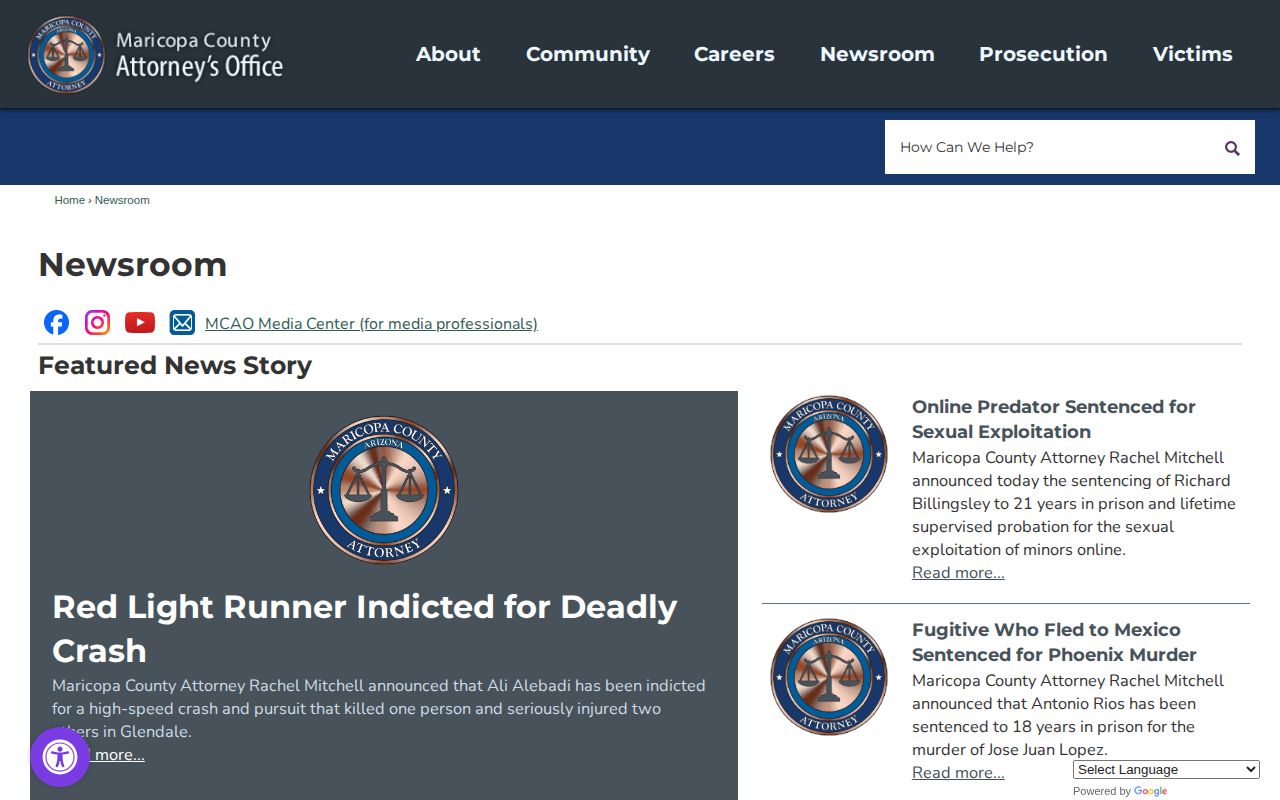
County attorneys post case announcements there. Charging context appears. Still, it is no full Maricopa booking feed.
Recent Arrests by Maricopa City
City police logs and county custody rosters cover some of the same people. They still answer different questions. Phoenix Police pushes adult county-custody bookings into MCSO systems, while its own portal handles police records. Mesa can hold a person in its staffed facility first, then route them to a city or county option. Chandler goes further with daily Arrest Bookings data. That feed includes police events beyond jail bookings.
- Phoenix Recent Arrests: Phoenix Police records and the MCSO handoff.
- Mesa Recent Arrests: city holding, city records, and county intake.
- Chandler Recent Arrests: daily police data and MCSO custody.
What Maricopa Arrest Records Show
A booking record is built at intake. Every field serves its own purpose. And each one can change on its own clock. The public card is just a thin layer over the internal custody file. It often holds less detail than the police report, the court docket, or the retained MCSO file, so anyone tracing an arrest later should save the booking number and the retrieval date.
| Field | What it shows |
|---|---|
| Full name | The name entered at booking; verify spelling against the court case. |
| Booking number | The MCSO intake identifier and best custody-search key. |
| Booking date/time | The intake event, which may be later than the street arrest. |
| Arresting agency | The agency that delivered the person; it may differ from the jail operator. |
| Charge text | Charges entered at booking. |
| Bond or release condition | Initial information that can change after a court order. |
| Current facility | Housing after classification, not always the intake site. |
| Photo | An intake image when made and when public release is allowed. |
| Court or case data | A route to later proceedings; the court controls its docket. |
| Release or transfer | A custody event, not a statement about guilt or case outcome. |
- Booking
- The jail intake process that creates a custody record.
- Arraignment
- A court hearing where formal charges are addressed and a plea may be entered.
- Bond
- A release condition set or reviewed by a court.
- Disposition
- The recorded outcome of a court case.
- Detainer
- A hold requested by another authority.
Maricopa Arrest Photos Changed
The sheriff's office took a strange path with mugshots. The old photo feature came down in September 2024. That removal followed the Ninth Circuit's ruling in Houston v. County of Maricopa. A redesigned return was announced in August 2025. The new arrest card is narrower and watermarked. Each card carries a booking number, first and last name, and charge information. The old display's detailed physical descriptors do not belong to the current card, and the KJZZ report on the revised MCSO photo lookup traces the whole policy shift.
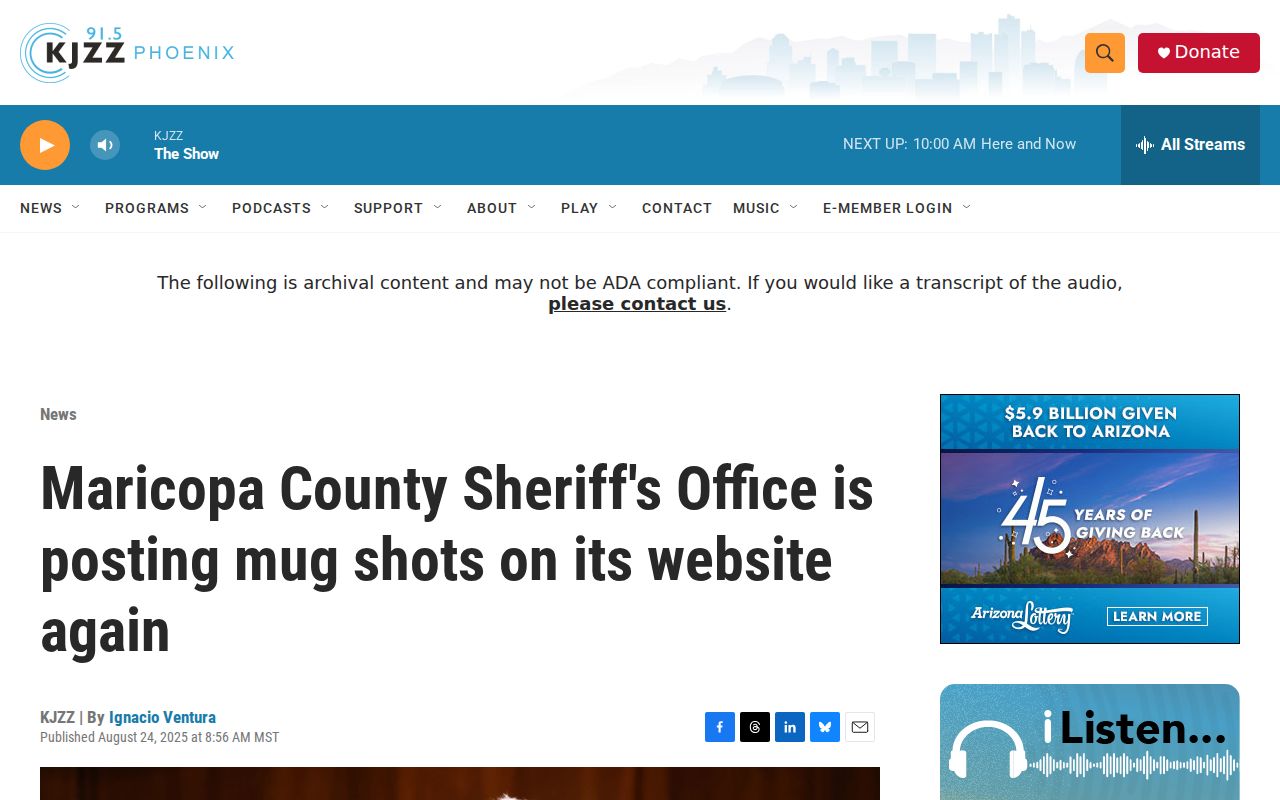
The August 2025 return is a policy fact, not a promise about today's screen. Card counts and interface details can shift. A photo can exist with no card showing. Quick release can hide a booking photo from view. So can a rolling-window cutoff, a restriction, an outage, or a later policy change. Ask MCSO directly when a lawful public copy is needed. The department alone controls what displays. Check back if a person seems missing from the arrest roster. A later ADCRR profile may carry a state institutional image. That image is not the current Maricopa booking photo.
Request a Maricopa Arrest Record
The lookup does not always deliver the full record. That is the moment for the Other MCSO Public Records request path. Keep the request narrow. Staff need the person's name, date of birth, incident or booking date, booking number, and the exact record sought. A request for "all records" is too broad. The arresting city holds its own police report. The court clerk keeps the docket and minute entries, and either office can fill a gap the county arrest record leaves open.
- Identify the custodian: MCSO, city police, court, or ADCRR.
- Provide the legal name, date of birth, event date, and known booking or case number.
- Name the item, such as a booking sheet, available booking photo, or custody event record.
- Choose inspection or the copy format and ask for a fee estimate.
- Keep the response, request number, and retrieval date with the record.
Fees depend on who holds the file. Maricopa County's general policy sets paper copies at $0.25 per page and charges nothing for electronic transfer. Other custodians differ. Mesa lists separate charges for photo media and a MAARS search, while Chandler bills report photos and video time separately. Phoenix uses its own portal and notices. The Maricopa County Public Records portal serves as the county's routing page, so confirm the posted fee with the office that actually holds the arrest record.
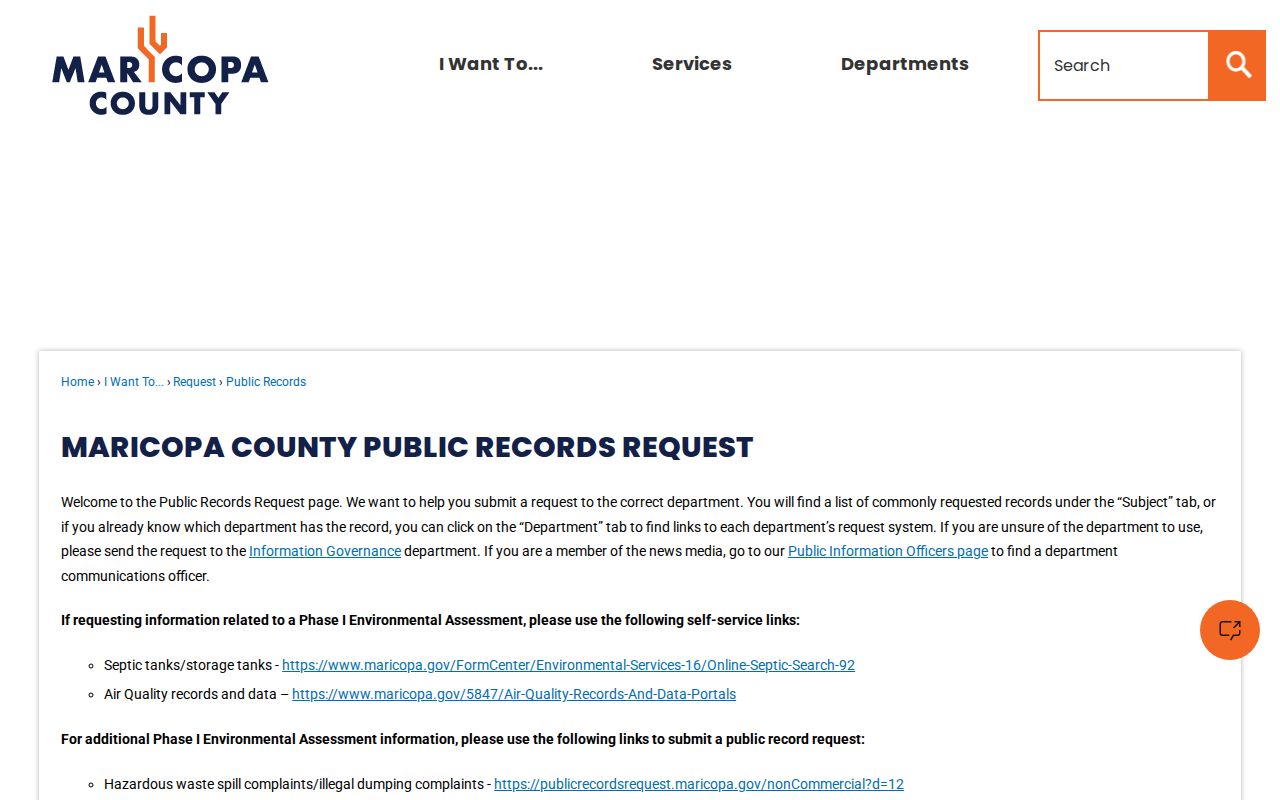
Agency links route each Maricopa record request. The right custodian answers. Every office controls its own responsive files and fees.
Arizona Arrest Records and Removal
A.R.S. §39-121 opens public records for inspection during office hours. Open access has limits. Not every record becomes a web post. Chandler's police dataset even labels a juvenile referral as an event. Privacy, victim, investigative, juvenile, and sealed material may be withheld or redacted, and the MCSO photo page and a court docket may hold back other fields too. "Not in this feed" does not mean it never happened.
Maricopa County has no single official mugshot-removal form. Start any correction with the source agency itself. For eligible cases, the Arizona Courts sealing process under A.R.S. §13-911 offers a court order. Send that order, or the corrected source record, to a publisher through its free legal or accuracy channel. Mugshots.com says it considers free removal after expungement. Arrests.org lists no clear free procedure for Maricopa pages. Check RecentlyBooked's policy live first. Never pay a service that demands money to alter a covered booking page. Only after the live source is removed or materially changed should a search engine be asked to refresh an outdated result. Indexing is separate from source removal, and sealing cannot guarantee that copies distributed earlier will disappear.
Maricopa Warrants and Wanted Notices
Two sources answer different questions here. MCSO's Warrant Lookup is the agency's check. The issuing court's warrant information and case docket can show the underlying matter, hearings, or later quashing activity. A person who thinks a warrant is wrong should contact the issuing court or an attorney. The Superior Court Criminal Department line is 602-506-8575.
The MCSO Most Wanted page is a public-safety notice, not a recent-arrest roster, and its live count, dates, offense text, photos, and tip directions can change. Never approach, follow, confront, or detain anyone listed. Verify MCSO's current tip channel independently. Agency material lists 602-876-TIPS (8477) for non-emergency tips. Call 911 for a true emergency. A stale screenshot or shared name is no safe basis for action.
After a Maricopa County Arrest
A Maricopa County arrest moves fast at first. County policy promises an initial appearance within 24 hours. That hearing can cover probable cause, release conditions, and the next event. The booking may appear before any court case. Arraignment opens a longer road. A case may then run through conferences, amended charges, dismissal, plea, trial, acquittal, conviction, or sentence.
Felonies point to the Superior Court Criminal Department search. Not every arrest ends up there. Misdemeanors may land in Justice Court or a municipal court, and a citation can create a police or court record with no county jail row at all. The arresting agency identifies the event, MCSO identifies county custody, and the proper court identifies the outcome. The official Maricopa Superior Court criminal resources page marks the court-side route.
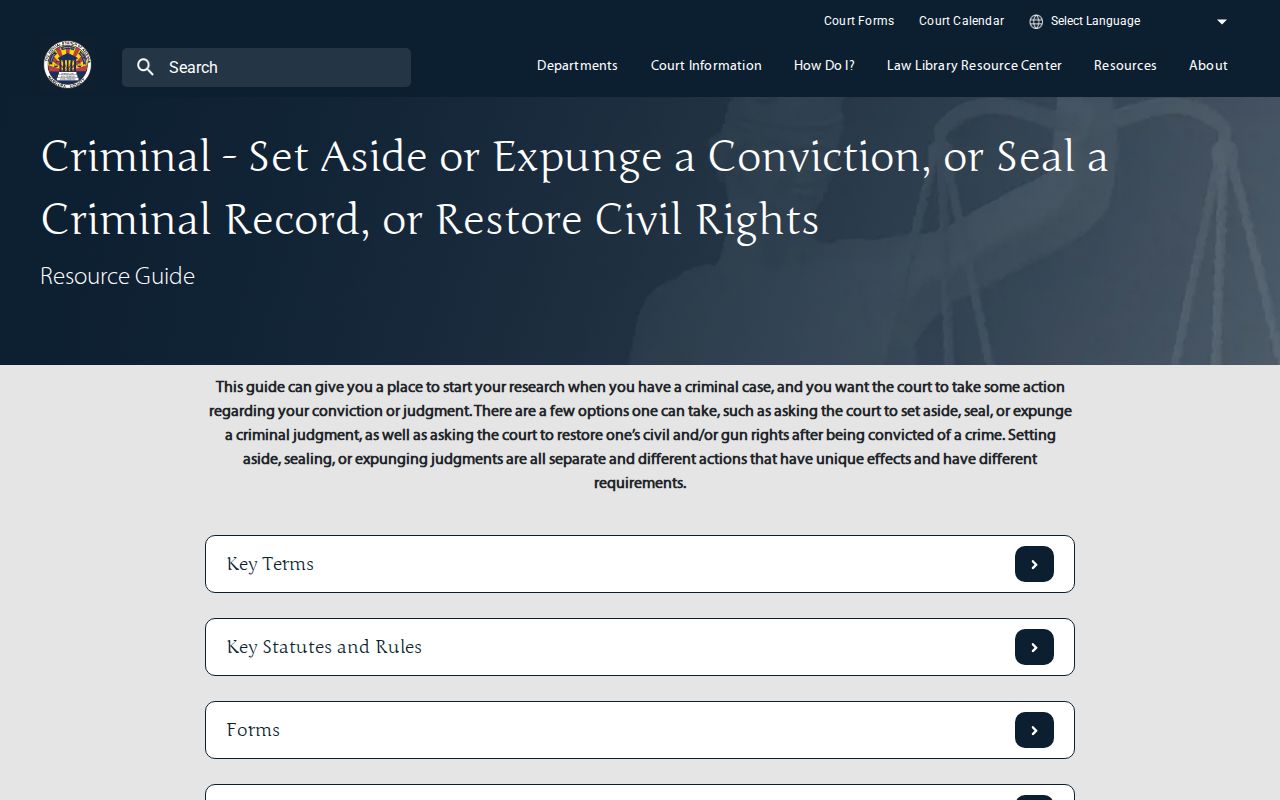
Courts take over after the arrest. Filed charges and hearings drive the record now. The booking card steps back.
Custody Beyond Maricopa Arrests
Custody does not always stay with the county. After a Maricopa County arrest, a person can be moved into state, federal, or immigration custody, and each path has its own lookup tool. The county roster only shows who is in a county jail right now. Federal Bureau of Prisons locator Starting with state prison, the Arizona Department of Corrections, Rehabilitation and Reentry Inmate Data Search is the official source. Search it by ADC number or name. That ADC number is not the same as an MCSO booking number. ADCRR also warns that release dates and release types can change. For federal custody, the Federal Bureau of Prisons locator is the right tool, though it is not a mugshot gallery. ICE runs its own detainee locator for immigration holds. Someone can also sit in a municipal holding path before the county accepts them.
Where did the record go? This is the question that trips up most searches. A release can drop a person off the current roster while the custody file and court record still exist. A state sentence shifts the custody search to ADCRR. A federal transfer shifts it to the BOP channel. Always compare what the official source shows with what the court holds. Arizona VINELink can track supported county and state custody events. It does not cover every federal, immigration, or municipal case.
Maricopa Arrest Files After Release
What happens to a Maricopa County booking file once a person walks out? MCSO's DB-1 policy says released custody-file components get combined. They are then sent to its records warehouse. Those custody files are kept for three years after release under the applicable schedule. That rule does not govern every police report. Nor does it govern photo copies, court files, or online mirrors. Arizona's retention schedules treat booking and detention records differently. They also fire on different triggers.
For a recent arrest, request MCSO or the arresting city first. Older court material may end up at the State Archives. Nothing shows that modern MCSO booking photos transfer there automatically. The Arizona State Library points current police requests elsewhere. They go back to the agency holding them. An unofficial page staying online proves nothing about the official record.