
The Maricopa County Arrest Log
The sheriff's office publishes no weekly blotter or 72-hour list. No stable multi-day arrest log exists either. Its official view is a rolling display of recent custody and booking photos. Treat it as a live window, not an archive. Any real multi-day review of Maricopa County arrests has to pull from several places at once. Start with MCSO for recent county custody. Then use the arresting police agency for its report, the right court for filed cases, and a targeted records request for an older booking.
No fixed window exists. MCSO posts no guaranteed multi-day range. No schedule governs its jail roster updates. Any date-browse pages you find on commercial sites are copied material. Those copies are not an official Maricopa County arrest log, so treat them with care.
The wider view earns its keep. An arrest record may first appear after weekend processing, then drop from the newest public card once the person is released or later bookings push it back. Each source captures a different stage. A police event can precede jail acceptance, a custody card reflects the booking itself, and a docket follows the case after filing.
Read Maricopa Arrests Across Days
Go to the official sources first. From there, work backward through the days you care about. Save the exact date of each search, since the public view shifts as bookings update. A booking number also beats a name for accuracy. Common names can match two different people arrested in Maricopa County.
- Check the MCSO Mugshot Lookup for the newest county booking cards.
- Use the inmate tools from the MCSO home page to check current custody.
- Identify the arresting agency. Phoenix, Mesa, and Chandler maintain different police-record channels.
- Search the correct court by case number or exact name for filed charges, hearing dates, and disposition.
- Request a specific older booking or police report through the county public-records portal.
For a fresh intake question, the 24 Hour Arrests page is the better route. The multi-day method exists to reconstruct dates and source transitions. It is not for watching a live queue. An empty search can mean release or transfer. It might point to a city holding route, a sealed matter, a spelling difference, or simple roll-off. It cannot prove that no arrest occurred.
Maricopa Arrest Log Fields
Every field tells you something about its source. The MCSO card open to the public shows less than the internal custody file behind it. A police dataset can be broader still. Details there do not always mean a county booking happened, so weigh each field against where it came from before you read it as part of the arrest record.
| Field | How to interpret it |
|---|---|
| Full name | Booking or police-record spelling. Confirm with another official identifier. |
| Booking or arrest number | The best link to the particular MCSO or police event. |
| Date and time | May mark arrest, report, or intake, depending on the source. |
| Arresting agency | The agency that made or reported the arrest, not always the housing agency. |
| Charge | An charge at that stage. Court filing and outcome may be different. |
| Photo | Subject to MCSO's current publication policy and rolling display. |
| Facility or release | A point-in-time custody status, not proof of sentence or guilt. |
Chandler's official arrest-bookings data goes deeper than the county card. It adds an arrest number, date and time. A generalized place, arrest class, charge severity, and an arrestee identifier round out the card. Some entries also cover citations or juvenile referrals. Others note releases that happened before booking. Phoenix and Mesa take a different path. They publish aggregate arrest counts rather than a public name-and-photo archive. The official Chandler catalog shows how a city police log differs from county custody.
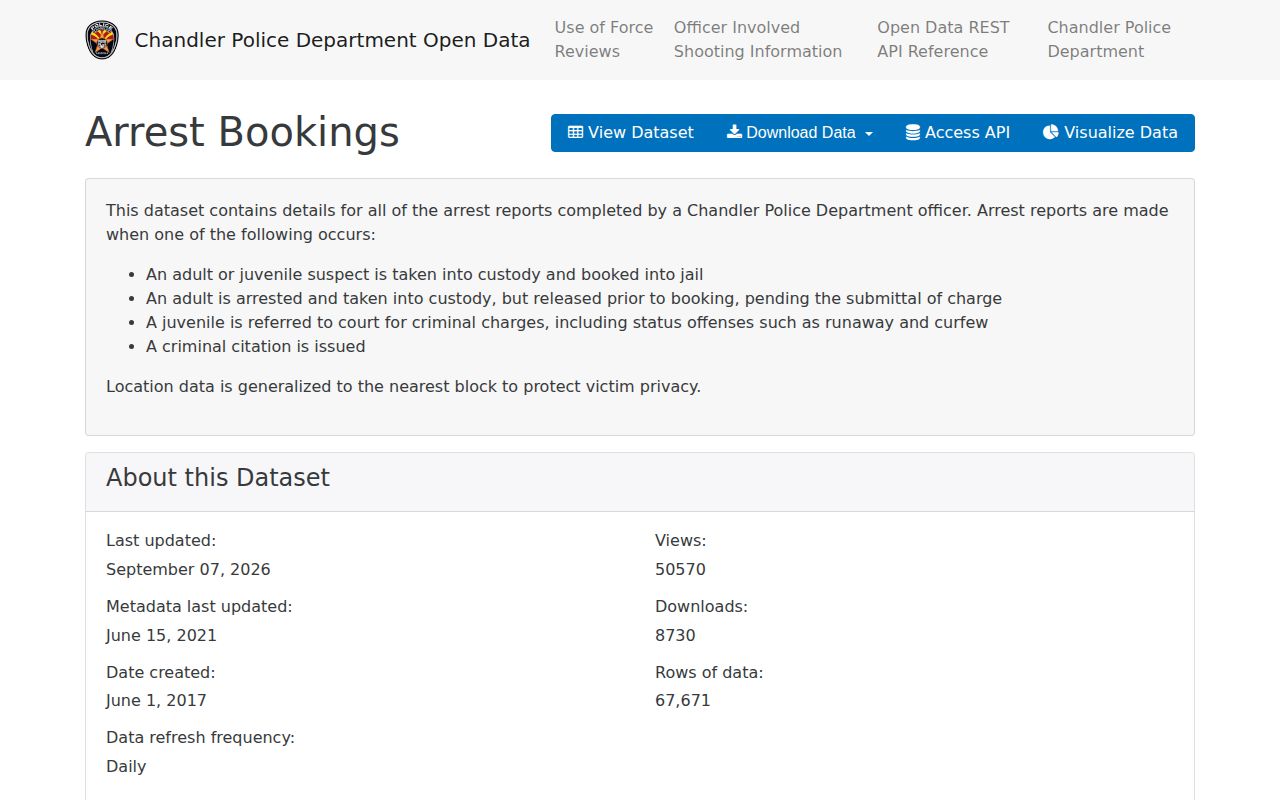
The city dataset refreshes daily. Its event categories stay broad. They do not track jail custody. So it cannot serve as an MCSO roster.
Weekend Maricopa Arrest Records
No official source promises a weekend surge, a holiday batch, or a set publication hour. Intake and initial-appearance work continue around the clock. Public websites update on their own schedules. City datasets do the same. Someone arrested late in the day may miss the same online cycle. Date and time labels can also point to different moments. They may mark the street arrest, the agency report, the jail booking, or the court filing.
Check the days on both sides of the date you expect. Note the time zone and your search time. Then set the MCSO event beside the arresting agency's record and the court docket. The Maricopa County recent-arrests hub lays out the full source ladder for one person. It spans county, city, state, and federal custody.
Maricopa Arrest Archives and Retention
The rolling MCSO card is not an archive. The custody file begins at intake. Under MCSO's DB-1 policy, it follows the person through booking, classification, housing, and release. After release, its parts are combined for records storage. The policy sets a three-year post-release retention rule for custody files. Other records answer to different schedules or legal holds. Ask the custodian for the exact booking record rather than an undifferentiated history.
For long-range context, turn to the Arizona State Library records program. It explains how state and local records are managed. Historical material can also shift into archival custody. That still does not put a name-indexed Maricopa County arrest log online.
This is a records-retention route, entirely separate from the newest public booking display. Access can be limited in several ways. A sealed record or a juvenile restriction may apply. Victim protection, investigative need, or a correction can also close it off. Copies distributed before sealing may persist elsewhere. Read archive silence as an access result, not as proof about the underlying event.
News Is Not an Arrest Log
Maricopa County has busy public-safety reporting. But no newspaper keeps a complete chronological roster of arrests. The ABC15 Crime and FOX 10 local news teams cover selected incidents. AZFamily, KJZZ, and Phoenix New Times do the same. The County Attorney newsroom posts selected charging, indictment, dismissal, and disposition announcements. Selection reflects news judgment, not the full booking population. The official County Attorney press-release feed can add case context.
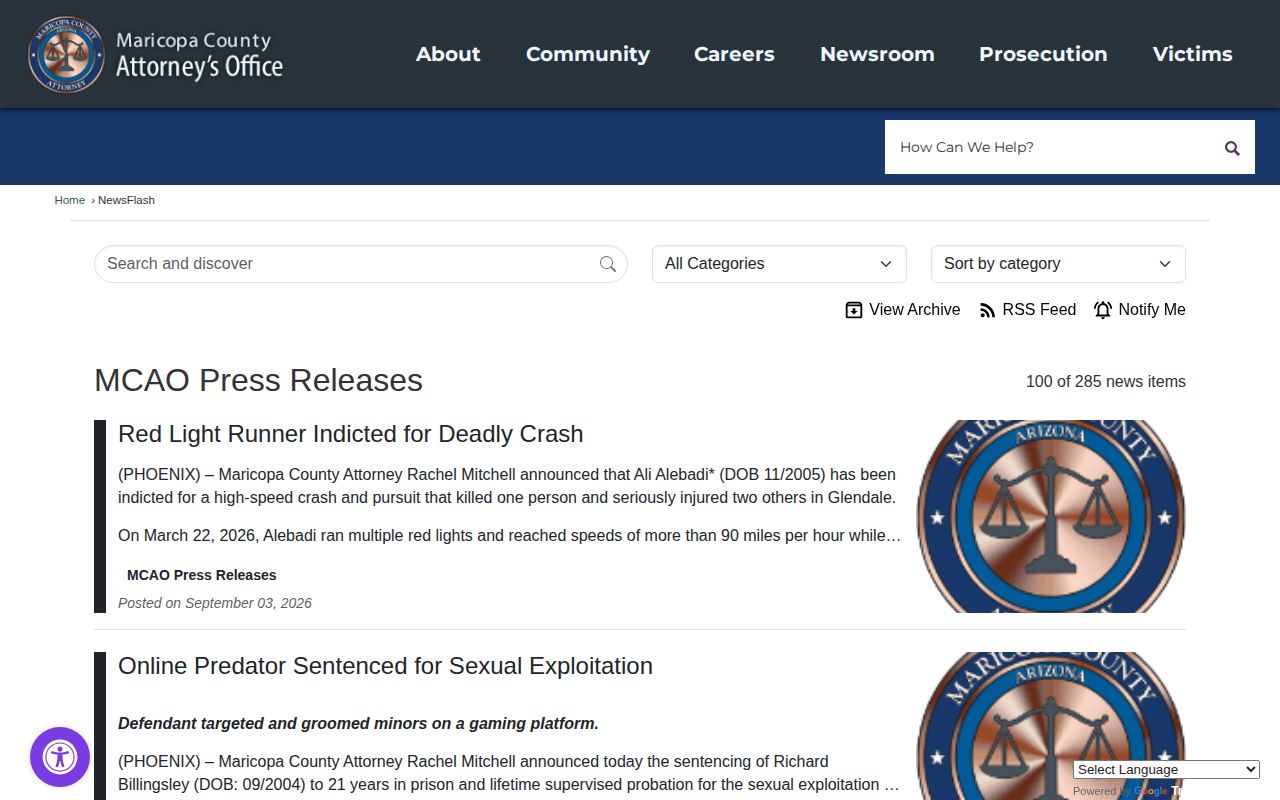
News coverage reaches past the arrest itself. Stories often cover later prosecution. That is different from a booking entry. Keep the two apart.
Unofficial Maricopa Arrest Archives
Two commercial archives round out the picture for Maricopa County arrest searches. RecentlyBooked Maricopa promotes a 30-day booking window. It also updates multiple times daily. Arrests.org Maricopa takes a different route with date-based browsing. Both sites copy their data from elsewhere. The unofficial RecentlyBooked county page exists here simply to mark a line. It separates copies from the agencies that actually run the jails.
Confirm any copied entry through MCSO, the arresting agency, and the correct court.
Unofficial archives aggregate old Maricopa arrest data. They are not primary sources. Records may be stale or wrong. Verify with official channels.